How an AI Agent Actually Books an Appointment
September 23, 2026 · Engineering · 6 min read
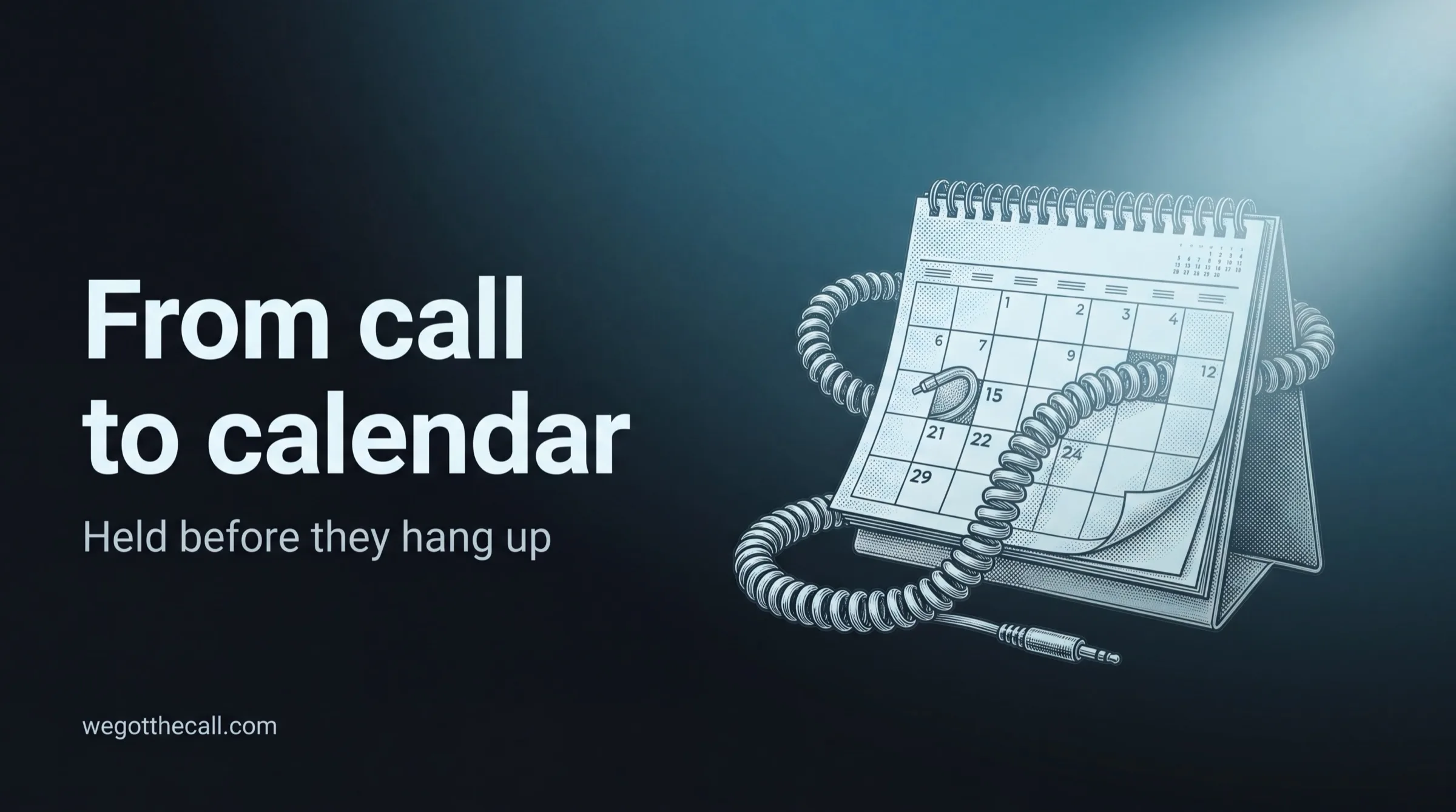
"It books appointments" covers a lot of ground, from writing a line in a spreadsheet to a genuine transaction against a live calendar. The difference shows up in your week, so it is worth knowing which one you are buying.
The sequence
1. Work out what is being booked. A 20-minute drain clear and a two-hour system diagnostic need different slots. Before touching the calendar, the agent needs the job type, which comes out of qualification.
2. Read live availability. Not a static template of "we work 8 to 5", but what is actually open today, accounting for existing jobs and whoever is off.
3. Filter by who can do it. If only two of your five techs handle boilers, a boiler job should not be offered a slot belonging to the other three.
4. Add travel time. A job across town needs a buffer. Without it you book a schedule that looks perfect and cannot physically be driven.
5. Offer two or three real windows. Not "when would suit you?", that produces "as soon as possible", which is not a time. Concrete options produce a decision.
6. Hold the slot immediately. The moment the caller picks, the slot is locked. This is the step cheap implementations skip, and it is the one that causes double bookings.
7. Write the booking with everything attached. Address, problem description, access notes, callback number, urgency flag, the recording link. The tech should not need to ring anyone.
8. Confirm in writing. A text with the date, the window and how to change it. Most no-shows are people who were not sure when you were coming.
The double-booking trap
The naive version is: read availability at the start of the call, talk for two minutes, write the booking at the end.
In those two minutes another caller can take the same slot. On a storm day, when calls arrive in parallel, this stops being a rare edge case and becomes the normal case.
The fix is a hold at the point of choice, and graceful handling when the hold fails: "that one has just gone, I can do 2pm or tomorrow at 9." Callers accept this without friction, because it is what a human dispatcher would say.
Arrival windows beat exact times
"Between 1pm and 3pm" is honest and survives a job running long. "1:15pm" is a promise that traffic breaks, and breaking it costs more goodwill than the precision ever bought.
Windows also let you compress a route later without ringing everyone back.
What should not be booked automatically
Some calls should be captured and handed to a person:
- Jobs needing a site visit to scope. A full re-pipe or a system replacement is an estimate, not a slot.
- Outside your service area. Capture and refer out, do not book.
- Callers who cannot authorise the work. Book when the decision-maker is on the line, or arrange to reach them.
- Anything already flagged as a genuine emergency. That goes to a human dispatcher who can move a truck, not into tomorrow's 10am.
Cancellations and reschedules
Booking is the easy half. The rest of it:
- Confirmation text, then a reminder the day before.
- An easy reschedule path, replying to the text should be enough.
- Automatic follow-up on no-shows, since a no-show is still a customer with a broken thing.
That last one recovers more revenue than most owners expect, and it is the same mechanism as missed-call text-back pointed at a different moment.
How to check a vendor's implementation
Three questions, and the answers are quite revealing:
1. When exactly is the slot held, at offer, or at confirmation? 2. What happens if two callers pick the same slot within thirty seconds? 3. How is travel time handled between consecutive jobs?
Vague answers to any of those mean you will be the one sorting out the calendar afterwards, which is the work you were trying to stop doing.
Common questions
- How does an AI agent book an appointment?
- It reads live availability from your calendar, offers the caller two or three real windows, places a hold on the one they choose so nothing else can take it, writes the booking with the job details attached, and sends a confirmation message, all while the caller is still on the line.
- Can an AI agent double-book my calendar?
- It can if it is built badly, by reading availability, then talking for two minutes, then writing without re-checking. A correct implementation holds the slot at the moment the caller picks it and treats a failed hold as "that one just went, how about this instead".
- Does it account for travel time between jobs?
- Only if it is configured to. A booking system that ignores drive time will happily put a 2pm across town after a 1:30pm, which is how you end up late to both. Buffers by area or postcode are what prevent it.