Why Contractors Lose Leads (and Where They Actually Leak)
September 23, 2026 · Operations · 6 min read
Ask a contractor why they lose work and the answer is usually price. Look at the numbers and price is well down the list, because most lost leads never reached a price conversation at all.
Here is where they actually go, roughly in order of cost.
1. The call that was never answered
The biggest leak in nearly every home service business, and the hardest to see. An unanswered call leaves no trace in your CRM, it exists only in the carrier log, which nobody opens.
Typical missed-call rates run 20% to 40% of inbound. The caller is not annoyed; they simply ring the next company, and you never learn it happened.
Fix: make sure every call is answered during jobs, at night, and when the line is busy. That is the entire argument for 24/7 cover, and the arithmetic is in what a missed call costs.
2. The callback that came too late
The web form submitted at 6pm and called back at 10am. By then the customer has spoken to two companies and probably booked one.
The gap is not the problem, the competitor who closed it is. Your callback is now interrupting somebody who already solved their problem.
Fix: respond in minutes, in the channel they used. How to measure and fix it.
3. The qualification that captured nothing useful
The call was answered, a name and number were written down, and nothing else. Now your dispatcher has to ring back to find out what is wrong, where, and how urgent, and about a third of those callbacks go unanswered.
Every callback is another chance to lose the job to someone who asked properly the first time.
Fix: a fixed question list, captured as structured fields, on every call. Here is the list.
4. The quote that was sent and forgotten
The estimate went out. Nobody followed up. Three weeks later it is dead, and it is recorded as "lost on price" even though the customer never said a word about price.
Quotes that receive two or three follow-ups close materially more often than quotes that receive none. The follow-up is not pushy, the customer is busy, and they were waiting for a nudge.
Fix: an automatic sequence that stops the moment they reply.
5. The no-show that was never rebooked
Somebody misses their window and it drops out of the schedule. Nobody rings. That customer still has a broken thing and will ring someone about it, just not you.
Fix: treat every no-show as an open lead with an automatic rebooking attempt, same day.
6. The lead that went to the wrong person
Multi-person shops: the enquiry lands in a shared inbox or a shared line, everybody assumes someone else has it, and nobody does. Small businesses lose more work to this than they admit, and it is invisible because everyone involved believes it was handled.
Fix: route on arrival to a named owner, with a visible "unclaimed" state that someone is responsible for clearing.
Find your own leak in twenty minutes
Count these five numbers over the last 90 days:
1. Inbound calls received (carrier log). 2. Calls answered. 3. Enquiries with enough detail to dispatch. 4. Quotes or bookings made. 5. Jobs completed.
The biggest percentage drop between consecutive stages is your leak. For most contractors it is between 1 and 2, and the fix is cheaper than anything they are currently spending on advertising to generate more calls into the same leaky pipe.
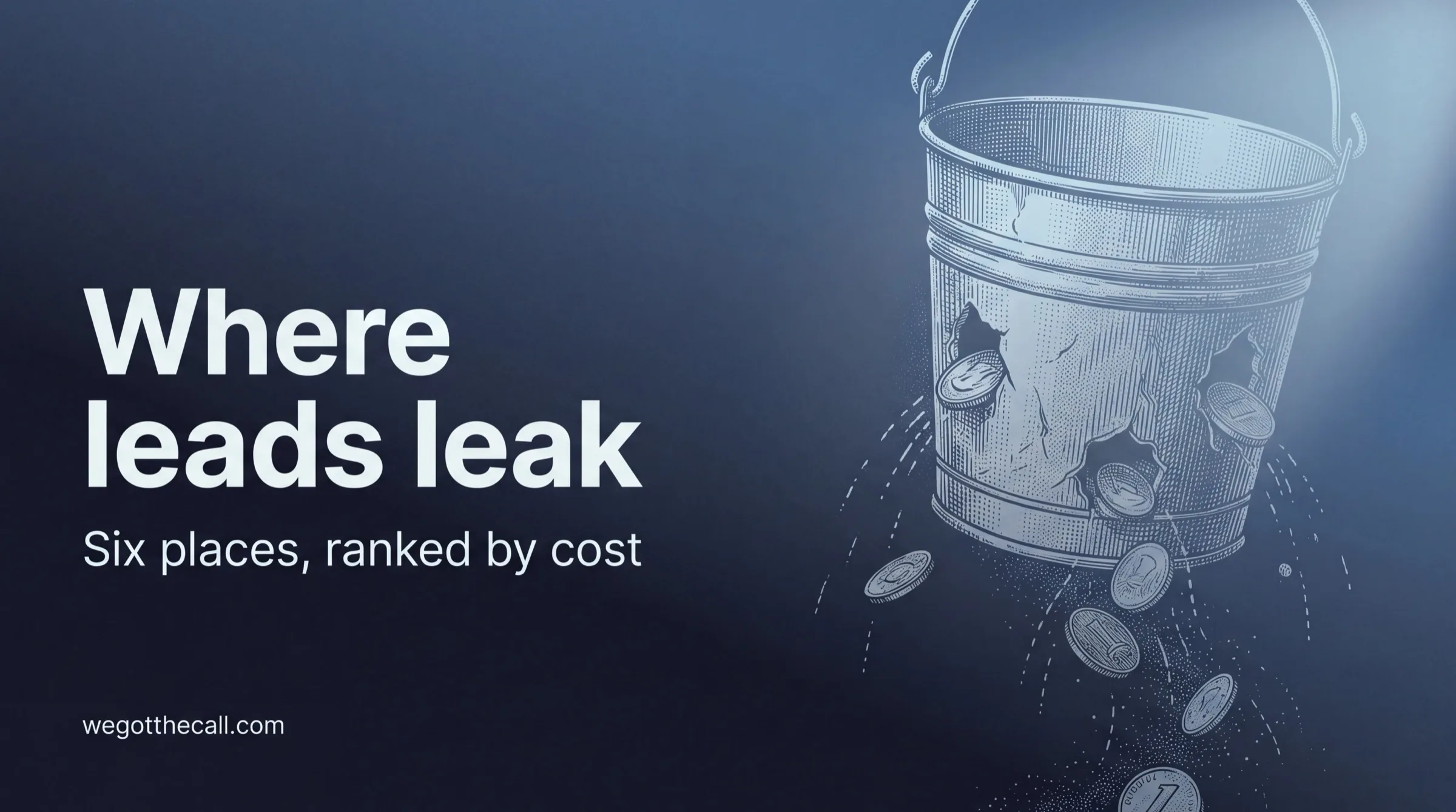
That last point is the one worth sitting with: buying more leads while 30% of your calls go unanswered is paying to fill a bucket with a hole in it.
Common questions
- Why do contractors lose leads?
- Most leads are lost before any selling happens: the call was not answered, the callback came hours later, the quote was never followed up, or the details captured were too thin to act on. Very few are lost on price.
- What is the biggest source of lost leads for home service businesses?
- Unanswered inbound calls. They are the largest category and the least visible, because an unanswered call usually leaves no record anywhere except the phone log.
- How do I find where my leads are leaking?
- Count enquiries at each stage, calls received, calls answered, enquiries qualified, quotes sent, jobs booked, over 90 days. The largest percentage drop between two stages is your leak, and it is rarely the stage you would guess.